

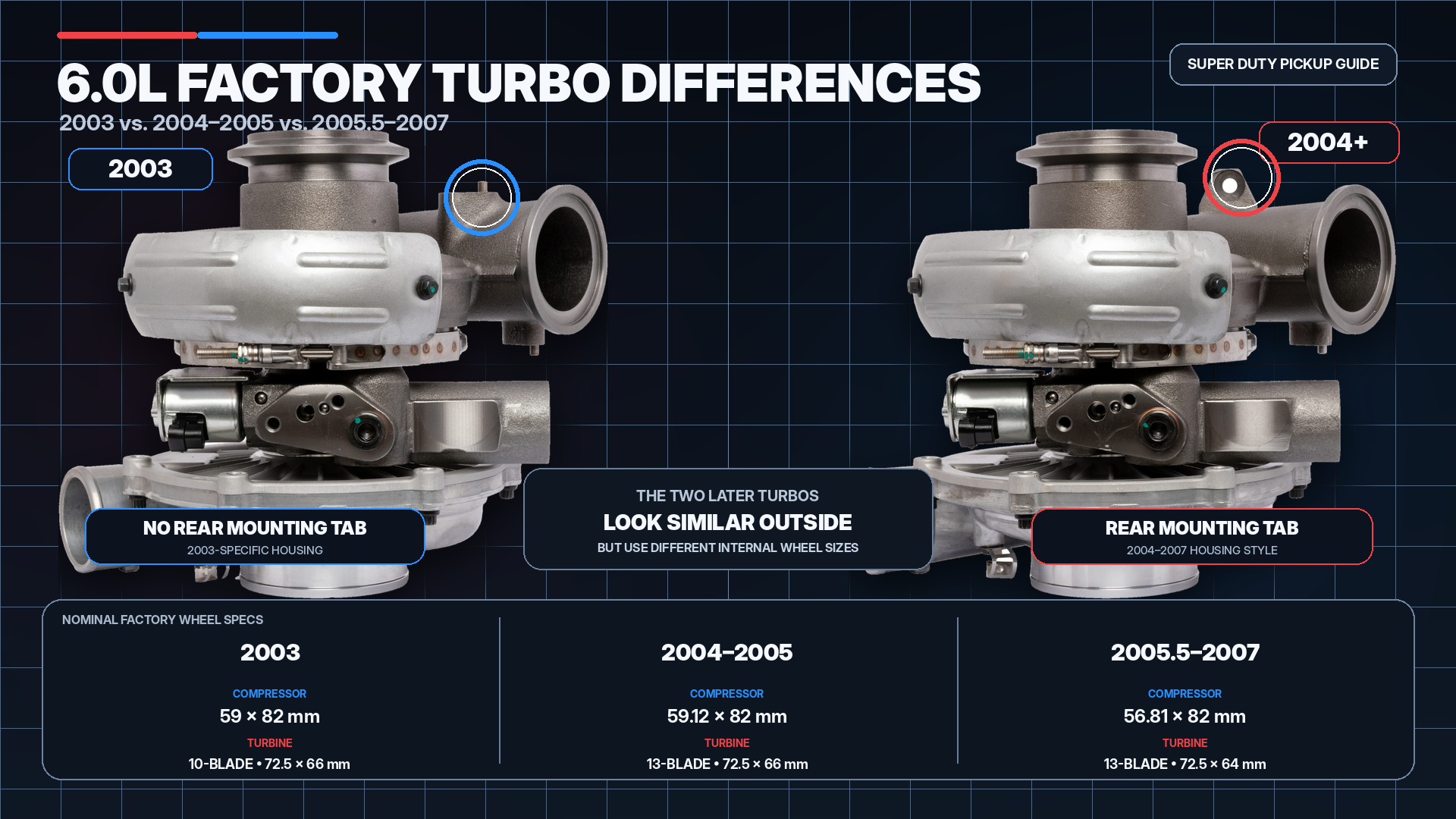
6.0L Powerstroke Factory Turbo Differences: 2003 vs. 2004–2005 vs. 2005.5–2007 Buyer’s Guide
The 6.0L Powerstroke uses three primary factory Garrett GT3782VA turbocharger configurations. Although all three use the same basic variable-geometry design, they are not internally or externally identical. Ford changed the turbine wheel, compressor wheel, center housing, turbine housing, and rear hold-down arrangement during production. This guide covers the 2003–2007 Ford F-250 through F-550 Super Duty, the 2003–2005 Ford Excursion, and the 2004–2010 Ford E-Series and Econoline equipped with the 6.0L Powerstroke. Unlike the 7.3L Powerstroke, the 6.0L Econoline does not use a separate van-specific turbocharger family; it uses the same applicable factory turbo configuration as the Super Duty and Excursion for the corresponding production period.
The Three Factory 6.0L Powerstroke Turbo Configurations
| Factory Configuration | Primary Applications | Ford Reman Service Number | Motorcraft Reman Number | Garrett New Number | Garrett Reman Number | External Identification | Compressor Wheel | Turbine Wheel |
|---|---|---|---|---|---|---|---|---|
| 2003 10-Blade Turbo | 2003 F-250 through F-550 Super Duty and 2003 Excursion | 3C3Z-6K682-CCRM | TC-13-RM | 725390-5006S | 725390-9006S | No rear mounting tab on the exhaust-side turbine housing; smooth machined hold-down area with a locating dowel | Approximately 59 mm inducer × 82 mm exducer | 10 blades; approximately 72.5 mm inducer × 66 mm exducer |
| 2004–2005 13-Blade Turbo | 2004 Super Duty, Excursion, and E-Series; earlier 2005 Super Duty and Excursion production | 4C3Z-6K682-CDRM | TC-15-RM | 743250-5024S | 743250-9024S | Rear mounting tab on the exhaust-side turbine housing; complete number needed to distinguish it from the later turbo | Approximately 59.12 mm inducer × 82 mm exducer | 13 blades; approximately 72.5 mm inducer × 66 mm exducer |
| 2005.5+ 13-Blade Turbo | Later 2005–2007 Super Duty, later 2005 Excursion, and 2005–2010 E-Series | 5C3Z-6K682-CCRM | TC-17-RM | 743250-5025S | 743250-9025S | Rear mounting tab on the exhaust-side turbine housing; complete number needed to distinguish it from the 2004–2005 turbo | Approximately 56.81 mm inducer × 82 mm exducer | 13 blades; approximately 72.5 mm inducer × 64 mm exducer |
About the specifications: The wheel measurements shown above are nominal published dimensions. Small measurement differences can occur because of production tolerances, superseded components, remanufacturing history, and the way a wheel is measured. The important distinctions are the overall wheel configurations: the 2003 turbo uses a 10-blade turbine measuring approximately 72.5 × 66 mm, the 2004–2005 turbo uses a 13-blade turbine measuring approximately 72.5 × 66 mm with the larger 59.12 mm-class compressor inducer, and the later turbo uses a 13-blade turbine measuring approximately 72.5 × 64 mm with the smaller 56.81 mm compressor inducer.
About the 2005 crossover: Ford’s published center-housing service information uses November 4, 2004 as the F-Super Duty service breakpoint and January 10, 2005 as the Excursion service breakpoint between Ford center housing 4C3Z-9G489-AARM and Ford center housing 5C3Z-9G489-AARM. The 2004 E-Series uses Ford center housing 4C3Z-9G489-AARM, while the 2005-and-later E-Series uses Ford center housing 5C3Z-9G489-AARM. These are Ford center-housing service breakpoints, so the complete number on the installed turbo should still be verified before ordering a complete assembly or internal hard parts.
How the Ford, Motorcraft, and Garrett Numbers Relate
Ford, Motorcraft, and Garrett use different numbering systems for replacement versions of the same basic factory turbo configuration. Ford’s complete-turbo service numbers use the 6K682 base number, while Motorcraft uses a TC-series number for the corresponding Ford-approved remanufactured turbo. Garrett offers both new and remanufactured versions of each configuration.
For example, Ford 5C3Z-6K682-CCRM, Motorcraft TC-17-RM, Garrett new 743250-5025S, and Garrett remanufactured 743250-9025S all reference the same later factory configuration. They do not represent four unrelated turbo designs. The condition, warranty, core requirement, and exact installation hardware included can still differ depending on which version is purchased.
Ford and Motorcraft numbers may also be displayed without dashes in online catalogs, invoices, and interchange databases. The common undashed versions are 3C3Z6K682CCRM and TC13RM, 4C3Z6K682CDRM and TC15RM, and 5C3Z6K682CCRM and TC17RM. A dashed and undashed version of the same complete number identify the same service reference.
What All Three Factory Turbos Have in Common
All three configurations belong to the Garrett GT3782VA variable-geometry turbo family. Rather than relying on a fixed turbine housing alone, the 6.0L turbo contains movable vanes surrounding the turbine wheel. The powertrain control module commands the VGT control valve, engine oil pressure moves the actuator piston and unison ring, and the unison ring changes the angle of the vanes. Closing the vanes accelerates exhaust flow against the turbine wheel for faster response at lower engine speeds, while opening the vanes increases exhaust-flow capacity and helps control boost and exhaust backpressure at higher engine speeds.
The same basic system is used in the Super Duty, Excursion, and Econoline. All three configurations can experience carbon buildup, corrosion, sticking vanes, unison-ring wear, damaged vane tabs, oil leakage, and bearing wear. For a detailed explanation of those failures and how to decide between cleaning, rebuilding, and replacing the turbo, see our 6.0L Powerstroke turbo problems and VGT sticking guide.
2003 10-Blade Factory Turbo
Common service references: Ford 3C3Z-6K682-CCRM, Motorcraft TC-13-RM, Garrett new 725390-5006S, and Garrett remanufactured 725390-9006S.
The 2003 factory turbo is the only configuration in this guide with a 10-blade turbine wheel. Its nominal turbine dimensions are approximately 72.5 mm at the inducer and 66 mm at the exducer. The compressor wheel measures approximately 59 mm at the inducer and 82 mm at the exducer. The 10-blade turbine and corresponding turbine-housing design produce the more pronounced whistle commonly associated with the 2003 6.0L Powerstroke.
The louder whistle does not automatically mean the 2003 turbo produces more boost, airflow, or horsepower. Its primary differences are the turbine blade count, sound, turbine-housing design, rear hold-down location, and center-housing construction. The 2003 and 2004–2005 turbos have similar nominal wheel diameters, but they are not the same complete turbocharger.
Externally, the 2003 turbine housing has a smooth machined hold-down area with a locating dowel. It does not have the rear extension or mounting tab found on the 2004-and-later turbine housings. The rear hold-down point corresponds to the 2003 pedestal arrangement, so the complete 2003 turbo should not be treated as a direct replacement for a 2004-and-later vehicle.
Ford lists two common 2003 center-housing service numbers: 3C3Z-9G489-AARM and 3C3Z-9G489-BARM. Ford center housing 3C3Z-9G489-BARM applies to the bolted center-housing construction without the separate clamp plate. This additional 2003 variation is important when purchasing a CHRA or attempting to reuse housings from an unidentified core.
2004–2005 13-Blade Factory Turbo
Common service references: Ford 4C3Z-6K682-CDRM, Motorcraft TC-15-RM, Garrett new 743250-5024S, and Garrett remanufactured 743250-9024S.
The 2004–2005 configuration changed from the 2003 turbo’s 10-blade turbine to a 13-blade turbine. Its nominal turbine dimensions remain approximately 72.5 mm at the inducer and 66 mm at the exducer, but the additional turbine blades change its exhaust-flow and sound characteristics. This turbo is generally quieter than the 2003 configuration and does not produce the same pronounced 10-blade whistle.
The compressor wheel measures approximately 59.12 mm at the inducer and 82 mm at the exducer. This is the larger compressor inducer of the two later-mount factory turbos. Compared with the 56.81 mm inducer used in the 2005.5-and-later configuration, the 2004–2005 wheel is approximately 2.31 mm larger at the inducer and has slightly more peak-flow potential. That difference should not be confused with the airflow increase provided by a true performance turbo upgrade.
Externally, the turbine housing has the later rear mounting extension or tab. This tab corresponds to the later pedestal and hold-down arrangement. The same general mounting architecture is used by the 2005.5-and-later turbo, so the mounting tab separates the 2003 turbo from the later turbos but does not reliably separate the two later configurations from each other.
The common Ford center-housing service number for this configuration is 4C3Z-9G489-AARM. Ford center housing 4C3Z-9G489-AARM applies to the 2004 E-Series, 2004 F-Super Duty, earlier-production 2005 F-Super Duty, and Excursions produced before the published 2005 service breakpoint.
2005.5+ 13-Blade Factory Turbo
Common service references: Ford 5C3Z-6K682-CCRM, Motorcraft TC-17-RM, Garrett new 743250-5025S, and Garrett remanufactured 743250-9025S.
The later factory configuration retains the 13-blade turbine and the rear turbine-housing mounting tab, but it uses a different rotating group. Its turbine wheel measures approximately 72.5 mm at the inducer and 64 mm at the exducer. The compressor wheel measures approximately 56.81 mm at the inducer and 82 mm at the exducer.
The smaller compressor inducer and turbine exducer change the turbo’s airflow, response, and compressor-surge characteristics. The smaller compressor was designed to provide greater surge resistance and smoother road manners. It should not be described as an inferior turbo simply because its compressor inducer is smaller. Ford and Garrett revised the operating characteristics rather than pursuing the largest possible factory compressor wheel.
Externally, the 2005.5-and-later turbo can look almost identical to the 2004–2005 turbo. Both have the later mounting tab, and both use 13-blade turbine wheels. The complete Ford, Motorcraft, or Garrett number is therefore the best way to separate them before disassembly. When the identification tag is missing, accurate compressor and turbine wheel measurements may be required.
The common Ford center-housing service number for this configuration is 5C3Z-9G489-AARM. Ford center housing 5C3Z-9G489-AARM applies to later-production 2005 Excursions, later-production 2005–2007 F-Super Duty applications, and 2005–2009 E-Series vehicles in Ford’s published service information. Current complete-turbo cataloging carries Ford 5C3Z-6K682-CCRM, Motorcraft TC-17-RM, Garrett new 743250-5025S, and Garrett remanufactured 743250-9025S through the 2010 E-Series.
Does the 6.0L Econoline Use a Different Turbo?
No. The 6.0L E-Series and Econoline do not use a separate van-specific turbocharger family comparable to the application differences found with the 7.3L Powerstroke. The 2004 6.0L E-Series uses the 2004–2005 configuration associated with Ford 4C3Z-6K682-CDRM, Motorcraft TC-15-RM, Garrett new 743250-5024S, and Garrett remanufactured 743250-9024S. The 2005–2010 E-Series uses the later configuration associated with Ford 5C3Z-6K682-CCRM, Motorcraft TC-17-RM, Garrett new 743250-5025S, and Garrett remanufactured 743250-9025S.
The Econoline’s tighter engine compartment makes turbo removal and installation substantially different from the same job in a Super Duty or Excursion, but the access problem should not be confused with a different turbocharger design. Turbo identification, rotating-group specifications, rebuilding, and hard-part matching follow the same configuration rules described in this guide.
External Differences: What You Can See Before Disassembly
Rear Turbine-Housing Mounting Tab
The strongest external difference separates the 2003 turbo from both later configurations. The 2003 turbine housing has a smooth machined hold-down area with a locating dowel and no rear mounting tab. The 2004–2005 and 2005.5-and-later turbine housings have an extension or mounting tab projecting from the exhaust side. This feature changes the relationship between the turbine housing, pedestal, and rear turbo hold-down bolt.
Identification Tag and Complete Service Number
The complete identification number is the most dependable way to separate the two later turbos. Clean the identification tag and the area around the VGT control-valve housing until every digit is visible. Record the entire part number, including every prefix, suffix, letter, and number. A partial number does not reliably identify which complete turbocharger configuration is installed.
Compressor-Housing Appearance
The compressor cover alone is not a reliable final identifier. A turbo that has been in service for twenty years may have received a replacement compressor cover, turbine housing, center section, VGT control valve, unison ring, or complete rotating assembly. A polished, painted, or freshly cleaned housing also does not prove which wheels are installed inside it.
Pedestal and Rear Hold-Down Location
The 2003 turbo uses a different rear hold-down location from the 2004-and-later turbos. The turbine housing and pedestal must be compatible. A complete 2003 factory turbo should therefore not be advertised or purchased as a normal direct bolt-on replacement for a 2004–2007 Super Duty, later Excursion, or 2004–2010 Econoline.
Internal Differences Between the Three Factory Turbos
Compressor-Wheel Differences
The 2003 compressor wheel is nominally approximately 59 × 82 mm. The 2004–2005 turbo uses an approximately 59.12 × 82 mm compressor wheel, while the 2005.5-and-later turbo uses an approximately 56.81 × 82 mm compressor wheel. The exducer remains approximately 82 mm across the three configurations, but the later compressor has a noticeably smaller inducer.
The similar compressor dimensions used by the 2003 and 2004–2005 turbos do not make the complete rotating groups interchangeable. Their turbine shafts, blade counts, center sections, turbine housings, and hold-down arrangements are different.
Turbine-Wheel Differences
The 2003 turbo uses a 10-blade turbine measuring approximately 72.5 × 66 mm. The 2004–2005 turbo changes to a 13-blade turbine while retaining approximately the same 72.5 × 66 mm dimensions. The 2005.5-and-later turbo also has 13 blades but reduces the turbine exducer from approximately 66 mm to 64 mm.
Blade count alone can separate the 2003 turbine from the two later turbines, but it cannot separate the 2004–2005 turbo from the 2005.5-and-later turbo. Both later versions have 13 blades, so the wheel dimensions or complete identification number must also be checked.
Center-Housing and CHRA Differences
Ford identifies the primary center-housing service numbers as 3C3Z-9G489-AARM or 3C3Z-9G489-BARM for the 2003 configuration, 4C3Z-9G489-AARM for the 2004–2005 configuration, and 5C3Z-9G489-AARM for the 2005.5-and-later configuration. A complete turbo, center housing, turbine shaft, and compressor wheel should not be treated as interchangeable merely because every version belongs to the Garrett GT3782VA family.
Basic Rebuild Kits Versus Internal Hard Parts
A basic rebuild kit containing journal bearings, piston rings, seals, and small hardware may be cataloged for more than one 6.0L turbo configuration. That does not mean the turbine shaft, compressor wheel, CHRA, compressor cover, or turbine housing is universal. Hard parts must match the specific rotating-group dimensions and housing contours.
This is particularly important with the two later turbos. A generic description such as “13-blade 6.0L turbo” is not enough information to order a turbine shaft or compressor wheel because both later configurations have 13 turbine blades but use different compressor inducer and turbine exducer dimensions.
Are the Three Factory Turbos Interchangeable?
Can the 2003 Turbo Replace a 2004-and-Later Turbo?
Not as a normal direct-fit factory replacement. The 2003 turbine housing uses a different rear hold-down location and corresponds to the 2003 pedestal arrangement. Installing the complete 2003 assembly on a later vehicle is not the same as removing one direct-fit turbo and installing another.
Owners who want the louder 2003-style whistle on a 2004-and-later vehicle should use a turbo specifically built with the later mounting configuration and a compatible 10-blade turbine. That provides the desired sound without creating a turbine-housing or pedestal compatibility problem.
Can Garrett 743250-5024S Replace Garrett 743250-5025S?
Garrett new turbo 743250-5024S and Garrett new turbo 743250-5025S share the same general later mounting architecture. Alliant Power states that the complete Garrett 743250-5024S and Garrett 743250-5025S assemblies can be used interchangeably without harmful effects. For the closest factory replacement, however, matching the complete configuration originally installed remains the best approach.
The configuration associated with Garrett new 743250-5024S, Garrett remanufactured 743250-9024S, Ford 4C3Z-6K682-CDRM, and Motorcraft TC-15-RM retains the larger compressor inducer and slightly greater peak-flow potential. The configuration associated with Garrett new 743250-5025S, Garrett remanufactured 743250-9025S, Ford 5C3Z-6K682-CCRM, and Motorcraft TC-17-RM is more optimized for compressor-surge resistance and smoother road manners. Neither should be presented as a major performance upgrade over the other.
Can the Internal Components Be Mixed?
Not simply because the two complete later assemblies share the same mounting arrangement. The compressor wheel, turbine shaft, compressor cover, turbine housing, and CHRA must match the intended rotating-group dimensions. Installing a 59.12 mm compressor wheel into a cover machined for a 56.81 mm wheel, or combining a 66 mm turbine exducer with a housing intended for the 64 mm wheel, can create incorrect clearances and immediate turbocharger damage.
Which Factory Turbo Is Right for Your Vehicle?
| Vehicle and Application | Correct Factory Service References | What the Buyer Should Verify |
|---|---|---|
| 2003 Super Duty or Excursion | Ford 3C3Z-6K682-CCRM Motorcraft TC-13-RM Garrett new 725390-5006S Garrett remanufactured 725390-9006S |
Confirm the 2003 turbine housing without the later rear mounting tab and identify which 2003 center-housing construction is present when rebuilding. |
| 2004 Super Duty or Excursion | Ford 4C3Z-6K682-CDRM Motorcraft TC-15-RM Garrett new 743250-5024S Garrett remanufactured 743250-9024S |
Confirm the later turbine-housing mounting tab and the 59.12 mm-class compressor configuration. |
| 2004 E-Series or Econoline | Ford 4C3Z-6K682-CDRM Motorcraft TC-15-RM Garrett new 743250-5024S Garrett remanufactured 743250-9024S |
The van uses the same applicable 2004 turbo configuration as the Super Duty and Excursion, not a separate van-specific turbo. |
| 2005 Super Duty or Excursion | Earlier configuration: Ford 4C3Z-6K682-CDRM Motorcraft TC-15-RM Garrett new 743250-5024S Garrett remanufactured 743250-9024S Later configuration: |
Read the complete installed turbo number. Use the vehicle build date and Ford’s published service breakpoint as supporting information, not as a substitute for identifying the turbo. |
| 2005–2010 E-Series or Econoline | Ford 5C3Z-6K682-CCRM Motorcraft TC-17-RM Garrett new 743250-5025S Garrett remanufactured 743250-9025S |
Confirm the later 56.81 mm compressor and 64 mm turbine-exducer configuration when purchasing internal hard parts. |
| 2006–2007 Super Duty | Ford 5C3Z-6K682-CCRM Motorcraft TC-17-RM Garrett new 743250-5025S Garrett remanufactured 743250-9025S |
Confirm that a previous owner has not installed a different later-mount replacement or performance turbo. |
How to Identify Your 6.0L Turbo Before Ordering
- Confirm the vehicle and model year. Determine whether the vehicle is a Super Duty, Excursion, or E-Series and record the exact model year.
- Locate the complete identification number. Clean the turbo identification tag and the area around the VGT control-valve housing until every number is visible.
- Record every character. Include the entire prefix, base number, suffix, letters, and dashes. Never search or order from only part of a part number.
- Inspect the exhaust-side turbine housing. A smooth machined hold-down area without the later mounting tab indicates the 2003 configuration. A rear mounting tab indicates one of the two later configurations.
- Pay particular attention to 2005 vehicles. A 2005 Super Duty or Excursion may use either later configuration. The 2005 E-Series uses the configuration associated with Ford 5C3Z-6K682-CCRM, Motorcraft TC-17-RM, Garrett new 743250-5025S, and Garrett remanufactured 743250-9025S.
- Check the vehicle’s repair history. A replacement engine, remanufactured turbo, performance turbo, or previous conversion may not match the vehicle’s original equipment.
- Measure the internal components when necessary. When the identification number is missing or unreliable, verify the compressor inducer, compressor exducer, turbine inducer, turbine exducer, and turbine blade count before ordering hard parts.
- Distinguish a complete turbo from rebuild components. A complete later-style turbo may have broader interchange than its individual wheels, shafts, covers, housings, and CHRAs.
Frequently Asked Questions
Did the 2004 6.0L Powerstroke Use the 2003 10-Blade Turbo?
No. The 2003 10-blade configuration is associated with Ford 3C3Z-6K682-CCRM, Motorcraft TC-13-RM, Garrett new 725390-5006S, and Garrett remanufactured 725390-9006S. The 2004 Super Duty and Excursion use the later turbine-housing mounting arrangement and the 13-blade configuration associated with Ford 4C3Z-6K682-CDRM, Motorcraft TC-15-RM, Garrett new 743250-5024S, and Garrett remanufactured 743250-9024S.
Why Does the 2003 Turbo Whistle More?
The 2003 turbo uses a 10-blade turbine wheel, while the two later factory configurations use 13-blade turbine wheels. The 10-blade turbine and 2003 turbine-housing design produce the more pronounced whistle associated with the 2003 6.0L Powerstroke.
Is the 2003 10-Blade Turbo More Powerful?
Not automatically. The louder whistle does not prove that the turbo produces more boost, airflow, or horsepower. Its most obvious differences are the turbine blade count, sound, turbine-housing design, center section, and rear mounting arrangement.
Are Garrett 743250-5024S and Garrett 743250-5025S the Same Turbo?
No. Garrett new 743250-5024S and Garrett new 743250-5025S both use 13-blade turbine wheels and the later turbine-housing mounting tab, but Garrett 743250-5024S has an approximately 59.12 mm compressor inducer and 66 mm turbine exducer. Garrett 743250-5025S has an approximately 56.81 mm compressor inducer and 64 mm turbine exducer.
Can the Two Later Turbos Be Interchanged?
Garrett new 743250-5024S and Garrett new 743250-5025S can be interchanged as complete later-style assemblies according to Alliant Power, but they are not internally identical. Matching the complete Ford, Motorcraft, or Garrett number remains the best approach when the goal is an exact factory-style replacement.
Can I Identify the Two Later Turbos by Counting Turbine Blades?
No. Both later configurations use 13-blade turbine wheels. The complete identification number or accurate compressor and turbine wheel measurements are needed to separate them reliably.
Which Turbo Does a 2005 Super Duty or Excursion Use?
A 2005 Super Duty or Excursion may use the configuration associated with Ford 4C3Z-6K682-CDRM, Motorcraft TC-15-RM, Garrett new 743250-5024S, and Garrett remanufactured 743250-9024S, or the later configuration associated with Ford 5C3Z-6K682-CCRM, Motorcraft TC-17-RM, Garrett new 743250-5025S, and Garrett remanufactured 743250-9025S. Read and cross-reference the complete number on the installed turbo. Ford’s published center-housing service breakpoints can provide supporting information, but the installed turbo number is the stronger final identifier.
Does the 6.0L Econoline Use a Different Turbo?
No. The 6.0L Econoline uses the same applicable factory turbo configurations as the Super Duty and Excursion. The 2004 E-Series uses Ford 4C3Z-6K682-CDRM, Motorcraft TC-15-RM, Garrett new 743250-5024S, or Garrett remanufactured 743250-9024S. The 2005–2010 E-Series uses Ford 5C3Z-6K682-CCRM, Motorcraft TC-17-RM, Garrett new 743250-5025S, or Garrett remanufactured 743250-9025S.
Can I Install the 2003 Factory Turbo on a 2006 Truck to Get the Whistle?
Not as a normal direct-fit stock replacement. The 2003 turbine-housing hold-down location differs from the later mounting arrangement. A later-mount turbo built with a compatible 10-blade turbine is the appropriate way to obtain the 2003-style sound on a later vehicle.
Can I Mix Internal Components From Garrett 743250-5024S and Garrett 743250-5025S?
Not without matching every wheel dimension, housing contour, operating clearance, and balancing requirement. The fact that complete Garrett 743250-5024S and Garrett 743250-5025S assemblies can interchange does not make their compressor wheels, turbine shafts, covers, housings, or CHRAs universally interchangeable.
Does a Factory-Style Replacement Turbo Require Tuning?
No special tuning should be required when the vehicle is otherwise stock and the correct factory-style complete turbo is installed. A performance turbo with substantially different compressor or turbine dimensions may have separate tuning and supporting-modification requirements.
The Bottom Line
The 6.0L Powerstroke uses three distinct factory turbo configurations. The 2003 configuration associated with Ford 3C3Z-6K682-CCRM, Motorcraft TC-13-RM, Garrett new 725390-5006S, and Garrett remanufactured 725390-9006S has a 10-blade turbine measuring approximately 72.5 × 66 mm, an approximately 59 × 82 mm compressor wheel, and a unique rear turbine-housing hold-down arrangement.
The 2004–2005 configuration associated with Ford 4C3Z-6K682-CDRM, Motorcraft TC-15-RM, Garrett new 743250-5024S, and Garrett remanufactured 743250-9024S has a 13-blade turbine measuring approximately 72.5 × 66 mm, an approximately 59.12 × 82 mm compressor wheel, and the later rear mounting tab.
The 2005.5-and-later configuration associated with Ford 5C3Z-6K682-CCRM, Motorcraft TC-17-RM, Garrett new 743250-5025S, and Garrett remanufactured 743250-9025S retains the 13-blade design and later mounting arrangement but uses a smaller 56.81 × 82 mm compressor wheel and a smaller 64 mm turbine exducer.
The same applicable factory turbo configurations are used across the Super Duty, Excursion, and Econoline. The Econoline does not require a separate van-specific 6.0L turbocharger design. Before ordering a complete turbo, CHRA, turbine shaft, compressor wheel, or housing, identify the complete Ford, Motorcraft, Garrett, or remanufacturer number on the installed turbo and inspect the rear turbine-housing mounting area. When the identification number is missing or unreadable, provide clear photographs and accurate wheel measurements before purchasing internal hard parts.
Recent Posts
 6.0L Powerstroke Factory Turbo Differences: 2003 vs. 2004–2005 vs. 2005.5–2007 Buyer’s Guide
 1999.5–2003 7.3L Power Stroke Turbo Upgrade Guide: Stock vs. Stock Plus vs. Stage 1 vs. Stage 2
 2007 Duramax LBZ vs. LMM: How to Tell Which Engine You Have
 6.0L Powerstroke Turbo Problems: VGT Sticking, Unison Ring Failure, and When to Rebuild vs. Replace
 Early 1999 vs. Late 1999 7.3L Powerstroke Turbos: How to Tell Which One You Have